Pickleball Court Lighting Guidelines Layouts, Foot-Candles, and Standards
Pickleball has taken the sports world by storm, becoming one of the fastest-growing recreational and competitive sports globally. As municipalities, private clubs, and venue operators expand court availability, providing high-quality night illumination is essential to maximizing court utilization.
Unlike larger court sports like tennis or basketball, pickleball involves a smaller, perforated ball moving at rapid speeds across a compact court (20′ x 44′). Players frequently engage in fast-paced net volleys and high lob shots, making glare control and optical precision paramount.
This guide outlines official pickleball court lighting guidelines, including foot-candle requirements, Anti-glare optical strategies, and optimal light pole layouts.
Pickleball Court Foot-Candles and Lux Standards
To ensure safety, visual comfort, and fair competition, illumination levels must match the venue’s level of play. Industry standards defined by ANSI/IES RP-6-21 and USA Pickleball facility construction guidelines categorize court lighting into three distinct classes:
- Class III (Community Parks & Casual Play): 20–30 Foot-Candles (200–300 Lux). Designed for residential complexes and public parks where the primary focus is recreational play and social matches.
- Class II (Clubs & High-Level Amateurs): 30–50 Foot-Candles (300–500 Lux). Suited for commercial pickleball clubs, tournament training facilities, and university courts requiring clear ball visibility during high-speed rallies.
- Class I (Professional Tournaments & TV Broadcast): 50–75+ Foot-Candles (500–750+ Lux). Required for national tournaments and venues hosting high-definition TV or slow-motion video broadcasting.
In addition to target foot-candles, maintaining high illumination uniformity ( ratio ) is critical to eliminating dark spots across the Non-Volley Zone (the “Kitchen”) and court baselines.
Overcoming Key Pickleball Lighting Challenges
Designing an effective lighting system goes beyond mounting bright fixtures; it requires addressing specific optical challenges:
High-Angle Glare Reduction
During lob shots and smashes, players constantly look upward toward the ceiling or sky. Standard floodlights create severe direct glare, momentarily blinding players. Professional fixtures utilize full-cutoff optics and specialized shielding to direct light strictly downward onto the playing surface.
Shadow Elimination
Because pickleball involves rapid footwork near the net, improper fixture placement can cast harsh body shadows across the court. Proper side-mounting configurations ensure multi-directional coverage, canceling out shadows around the net and kitchen lines.
Dark Sky & Spill Light Compliance
Many pickleball courts are situated in residential neighborhoods. Using precision optics prevents light spill and sky glow, complying with municipal Dark Sky regulations while keeping neighboring properties dark.
Recommended Pole Layouts for Pickleball Courts
Proper pole placement prevents direct glare while ensuring even light coverage across the entire playing area.
- Pole Height: Standard pole heights range from 20 to 26 feet (6 to 8 meters). Lower heights create excessive glare at eye level, while higher poles needlessly increase wind load and structural costs.
- Side-Mounting Strategy: Light poles should always be placed along the sidelines (Side Mount) rather than directly behind the baselines. This layout keeps high-intensity light beams out of the main line of sight when players serve or return deep shots.
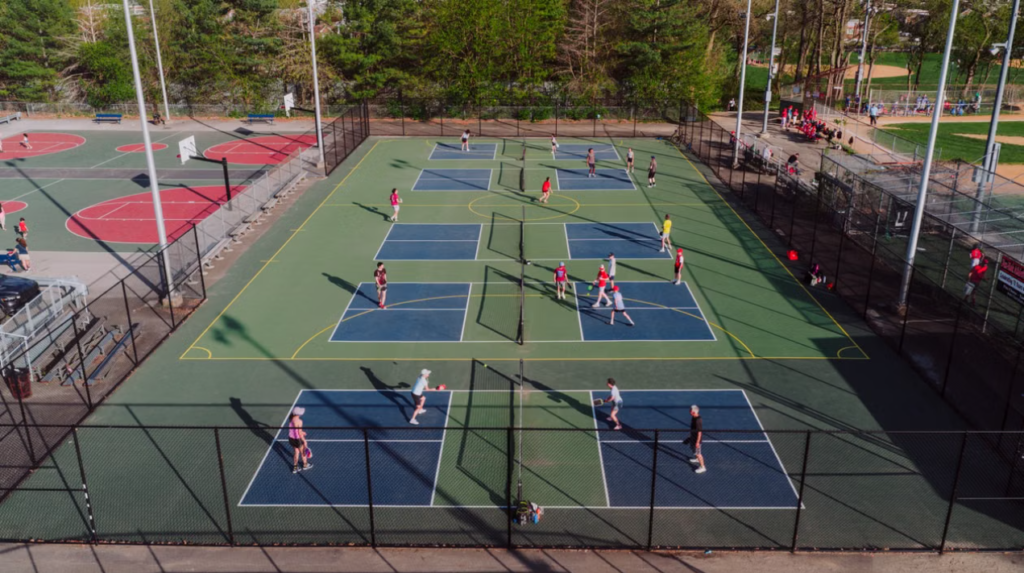
- Single Court Layout: A typical single court uses a 4-pole or 6-pole side-mounted configuration, placing fixtures outside the primary playing zone.
- Multi-Court Layout: For row courts, shared high-mast poles with dual-head LED fixtures offer an efficient solution that reduces total infrastructure and trenching costs.
Why Upgrade to LED Sports Lighting for Pickleball?
Transitioning from legacy metal halide systems to modern LED sports lights offers immediate operational and financial advantages:
- Energy Savings: High-efficiency LED sports field lighting reduces electricity consumption by up to 60%–70% compared to traditional HID lamps.
- Instant On/Off: Zero warm-up delay allows court operators to instantly toggle or dim lights between sessions.
- Flicker-Free Performance: Advanced LED drivers ensure flicker-free lighting required for high-speed action and mobile camera recordings.
Professional Pickleball Lighting Solutions by Unilumin Sports
Achieving the perfect balance of illumination, uniformity, and glare control requires specialized engineering. Unilumin Sports delivers turnkey LED sports lighting systems engineered specifically for modern athletic venues. By integrating advanced non-glare optics, superior thermal management, and smart lighting controls, Unilumin Sports provides customized solutions that minimize long-term total cost of ownership.
Ready to Light Up Your Pickleball Venue?