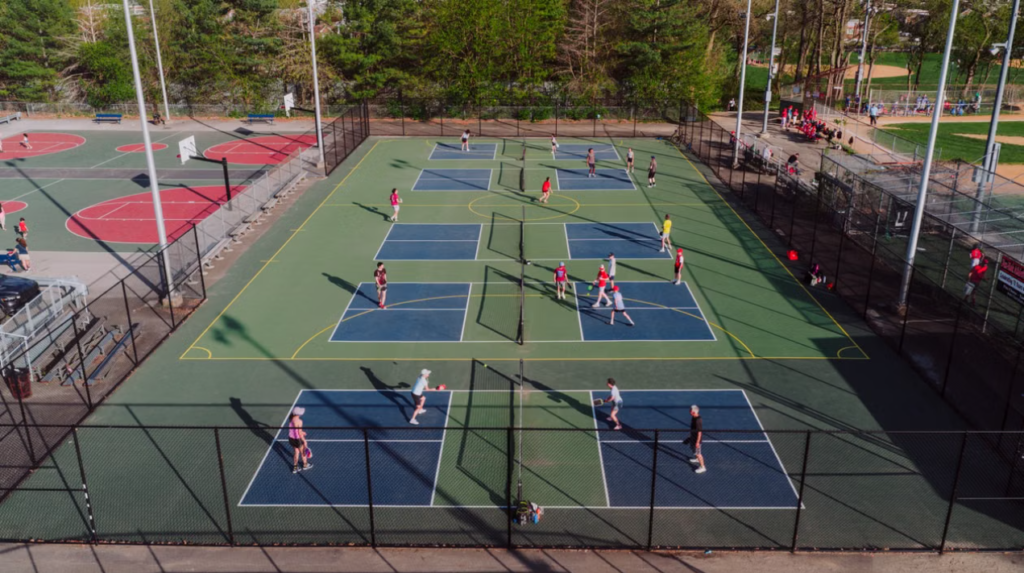
How Do You Reduce Glare on a Pickleball Court?
Glare is one of the most important factors to consider when designing pickleball court lighting. A court can have enough light to play at night and still feel uncomfortable if players are constantly looking directly into bright fixtures.
Because pickleball involves frequent overhead shots, lobs, and fast ball movement, players need to track the ball through a wide field of view. Poorly positioned or poorly controlled pickleball court lights can create direct glare, reduce visual comfort, and make it harder to follow the ball.
So, how do you reduce glare on a pickleball court? The answer is not simply to use less light. Effective glare control requires the right combination of pole placement, mounting height, optical distribution, fixture aiming, and light shielding.
1. Why Is Glare a Problem in Pickleball?
Pickleball requires players to react quickly to a small, fast-moving ball. When players look upward to track a lob or overhead shot, a poorly positioned light source can enter their field of view.
USA Pickleball recommends that court lighting should be distributed uniformly across the playing area and that glare should be minimized as much as possible. It also recommends avoiding reflective surfaces and controlling the amount of light directed onto the court. In practice, excessive glare can lead to:
- Reduced visual comfort
- Difficulty tracking the ball Eye fatigue
- Distracting bright spots
- Poorer visibility during overhead shots
- Light spill into surrounding areas
This is why good pickleball court lighting is about more than simply making the court brighter.
2.4 Ways to Reduce Glare on a Pickleball Court
1. Position Light Poles Outside the Players’ Main Sightlines
Light pole location has a major influence on glare.
USA Pickleball recommends keeping light poles at least 5 feet from the court sideline and positioning them on or immediately outside the fence or court where possible.
The objective is to position the fixtures so they can illuminate the court without placing bright light sources directly in players’ primary lines of sight.
For multi-court facilities, pole placement becomes even more important because fixtures may need to illuminate several courts while avoiding glare between adjacent playing areas.
2. Use the Right Mounting Height
Mounting height affects both coverage and glare.
If fixtures are mounted too low, the light source can remain within the player’s viewing angle during overhead shots. Raising the mounting position can help distribute light over a larger area and change the fixture’s position relative to the player’s sightline.
However, higher is not automatically better.
The appropriate height depends on:
- Number of courts
- Court layout
- Fixture output
- Optical distribution
- Pole location
- Required lighting performance
USA Pickleball notes that larger lighting areas may require higher poles, while its official lighting partners provide different mounting configurations depending on court classification and facility layout. The goal should be to find the right balance between coverage, uniformity, and glare control.
3. Choose Fixtures with Precise Optical Control
Not all LED fixtures are designed for sports lighting. General-purpose floodlights may send light in directions where it is not needed, increasing the risk of glare and light spill. Purpose-built sports lighting can use more controlled optical distributions to direct light toward the playing area.
4. Control Fixture Aiming and Shielding
Even a high-quality fixture can cause glare if it is aimed incorrectly. The fixture should be aimed to provide useful illumination across the court while minimizing direct visibility of the LED source. Depending on the project, glare control can include: Proper fixture aiming
- Optical shielding
- Visors or louvers
- Controlled beam distribution
- Appropriate pole positioning
- Reduced backlight and uplight
For outdoor facilities, controlling spill light is also important when courts are located near homes, roads, or other properties.
How Unilumin Sports Approaches Pickleball Court Lighting
For a professional sports lighting project, glare control should be considered from the beginning of the design process rather than treated as an installation problem afterward. Unilumin Sports focuses on sports lighting solutions that combine fixture performance, optical control, pole layout, and project-specific lighting design.
👉 [Contact Unilumin Sports Today for Lighting Design]