


Outdoor vs. Indoor Basketball Court Lighting: Key Differences According to FIBA Rules
- LED Sport lighting
- Indoor Basketball Lights
- LED Basketball Court Lighting
Proper illumination is the backbone of safety, athletic performance, and broadcast quality in modern sports venues. While the dimensions of a regulation basketball court remain identical regardless of venue type—28 meters long by 15 meters wide—the optical, environmental, and mechanical demands for outdoor basketball lighting and indoor basketball lighting could not be more distinct.
Whether you are an engineering contractor, stadium developer, or municipal procurement director, understanding these core distinctions through the lens of the official FIBA (International Basketball Federation) Equipment & Lighting Guidelines is critical. In this comprehensive guide, Unilumin Sports breaks down the essential technical differences between indoor and outdoor LED basketball lighting installations, from ingress protection ratings to advanced glare mitigation and light distribution strategies.

1. Environmental Protection: Ingress Ratings and Structural Durability
The most immediate difference between indoor and outdoor lighting systems lies in their exposure to environmental elements.
Outdoor Basketball Lighting Demands
Outdoor fixtures face non-stop exposure to harsh weather conditions, including torrential rain, extreme ultraviolet (UV) radiation, dust, wind loads, and thermal expansion.
- Ingress Protection (IP Rating): FIBA guidelines require outdoor sports floodlights to possess a minimum protection rating of IP66. This ensures complete protection against dust ingress and high-pressure water jets from any direction.
- Impact Resistance (IK Rating): Outdoor fixtures installed on high masts are susceptible to high winds and mechanical impacts. An IK08 to IK10 structural rating is required to safeguard the luminaire housing and tempered glass lens against damage.
- Surge Protection: Lightning strikes and power grid fluctuations are catastrophic to high-power LEDs.

Indoor Basketball Lighting Demands
Indoor arenas do not contend with direct rainfall or freezing temperatures, but they introduce unique environmental challenges of their own.
- IP Rating: Indoor high bays and floodlights typically utilize an IP54 to IP65 rating, which easily shields internal diodes from facility dust and moisture.
- Thermal Management: Enclosed indoor facilities can trap ambient heat near high ceiling trusses. Fixtures require advanced passive thermal heat sinks—utilizing high-purity die-cast aluminum—to dissipate heat effectively without relying on noise-generating cooling fans.
- Ball Impact Resistance: Ball strikes are much more frequent on indoor ceiling-mounted and side-mounted fixtures. Consequently, IK08 impact certification is non-negotiable to prevent glass shattering above players.

2.Optical Reflection and Spill Light Control
Controlling where light travels—and preventing it from going where it shouldn’t—requires two completely different optical approaches indoors versus outdoors.
Spill Light and Dark Sky Compliance (Outdoor)
One of the primary challenges of outdoor basketball lighting is spill light (obtrusive light that falls outside the court boundary) and sky glow. Outdoor courts are frequently located near residential neighborhoods, parks, or adjacent sports fields.
To comply with international environmental light pollution codes (such as CIE 150), outdoor luminaires must feature zero Upward Light Ratio (ULR = 0%). A professional team solves this by engineering custom asymmetrical forward-throw optical lenses combined with top-mounted cut-off visors. This precise distribution throws light uniformly across the court surface while keeping the optical face horizontal, drastically cutting off light trespass into adjacent properties.
3. FIBA Performance Standards: Indoor vs. Outdoor Parameters
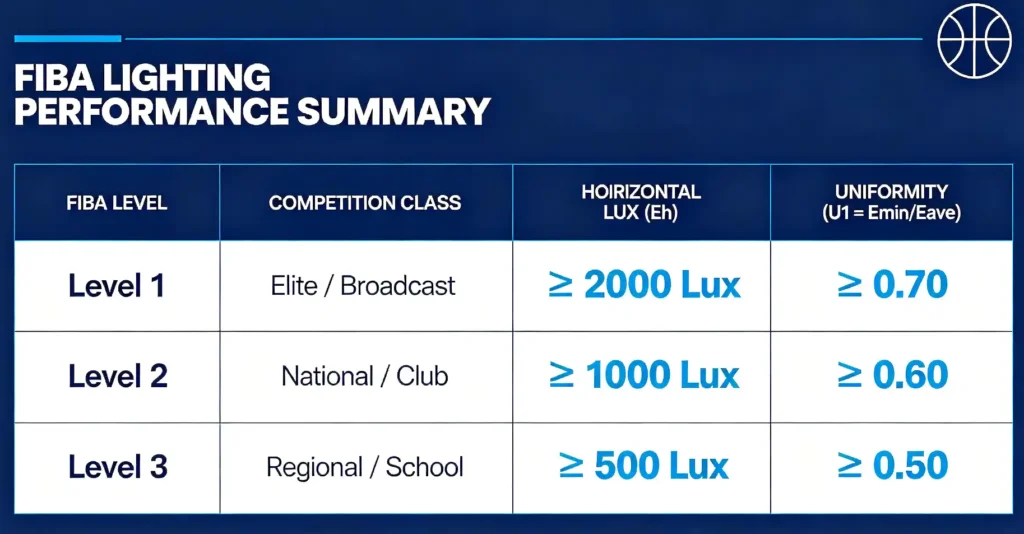
FIBA categorizes basketball competition into three distinct lighting levels based on venue capacity and broadcast requirements. The photometric requirements differ significantly depending on whether high-definition television (HDTV) broadcasting is present.
Lux Levels and Illuminance Uniformity
FIBA Level 1 (Top-Level International & TV Broadcast): Requires an average horizontal illuminance (Eh) of≥ 2000Luxand a vertical illuminance (Ev) facing main camera positions of ≥1500Lux. Illuminance uniformity (U1 = Emin/Eave) must be exceptional (≥ 0.70) to prevent dark patches on camera feeds.
FIBA Level 2 (National & Regional Competitions): Requires ≥ 1000Lux average horizontal illuminance with U1 ≥ 0.60.
FIBA Level 3 (Recreational & School Courts): Standard requirement is ≥ 500Lux for indoor facilities, though outdoor community courts occasionally operate at 200 – 300Lux for casual night play.
4. Mounting Heights and Structural Layouts Physical fixture positioning is dictated entirely by architectural and structural limits.
Outdoor High-Mast Layouts
Outdoor installations rely on lighting poles erected around the perimeter of the court. FIBA explicitly prohibits placing poles directly behind the baselines to protect the shooter’s visual field during free throws and layups.
- Pole Heights: Typically range between 7 meters and 12 meters.
- Configurations: The most common setups are 4-pole layouts (economical, for Level 3 courts) and 6-pole layouts (professional, for Level 1 and 2 courts).
- Aiming Angles: Main beam aiming angles must remain below 65° relative to the downward vertical axis to limit direct glare for players driving to the basket.
Indoor Overhead and Perimeter Layouts
Indoor venues utilize ceiling trusses, catenaries, or sidewall structures.
- Mounting Heights: Indoor clear ceiling heights vary from 7 meters in small school gyms to over 15 meters in professional arenas.
- Overhead Grid Layout: High-bay luminaires are arranged in uniform grid patterns above the playing field outside of the central basket trajectory.
- Sidewall Lighting: In high-ceiling arenas, non-asymmetric floodlights are mounted along side catwalks, aiming inward at low tilt angles to achieve high vertical illuminance (Ev) for side-view broadcast cameras.

5.Partnering with Unilumin Sports for FIBA Compliance
Designing a basketball lighting system is far more complex than simply mounting bright lights. From calculating precise Lux uniformity and controlling spill light on outdoor high masts to eliminating reflected glare under indoor ceilings, every project demands tailored optical engineering.
As a global leader in professional sports lighting and display solutions, Unilumin Sports delivers full turnkey FIBA-compliant systems. Our engineering team provides custom Dialux optical simulations, advanced LED basketball lighting fixtures, and long-term project support tailored to your venue’s unique layout.
Ready to upgrade your indoor arena or outdoor basketball court? Contact the sports lighting specialists at Unilumin Sports today to request your customized Dialux optical lighting design and quotation!
More Posts

How to Choose the Right Badminton Court LED Lighting System
How to Choose the Right B

Badminton Court Lighting Guide: BWF Standards, LED Selection and Anti-Glare Solutions
Badminton Court Lighting

Professional Basketball Court Lights vs. Standard Lighting: The Complete Buyer’s & ROI Guide
Professional Basketball C